Showing posts with label Heritage. Show all posts

Tuesday, 11 August 2015

July 30: The eye

I have no idea what this is or was used for. The steel eye is drilled into rock located to the south of the Isthmus on the eastern shore near landing beach. It may have been related to resupply activities or boating. If I find out more I will provide an update.  It makes for an interesting picture though.


Steel eye. Photo: Jacque Comery

Thursday, 6 August 2015

July 24: The Station cats...

Cats were first introduced to Macquarie Island by sealers, brought ashore to help protect food stores from rodents also introduced to the island by ships. No doubt they also quickly became companions to men living a harsh and lonely existence. With little food and being left to fend for themselves  some strayed and soon became wild. Whilst cats were first mentioned as living on the island in 1820, it was likely that they were present before this. By 1912 feral cats were described as being numerous.

Sir Douglas Mawson himself  in his address to the Australian Geographic Society in 1919 declared his opinion that the cats of the island were a menace to birdlife and should be exterminated.
In the 1970's it was estimated that there were  170 to 250 cats on the island killing 60,000 burrowing seabirds annually.

In 1996 the  Commonwealth and Tasmania Governments funded a five year cat eradication program, which was declared a success in 2002, and the island remains cats free today.
A few pelts hang in Tasmanian Parks office on Station, a testament to the wily hunters that prevailed on the island for almost two centuries.
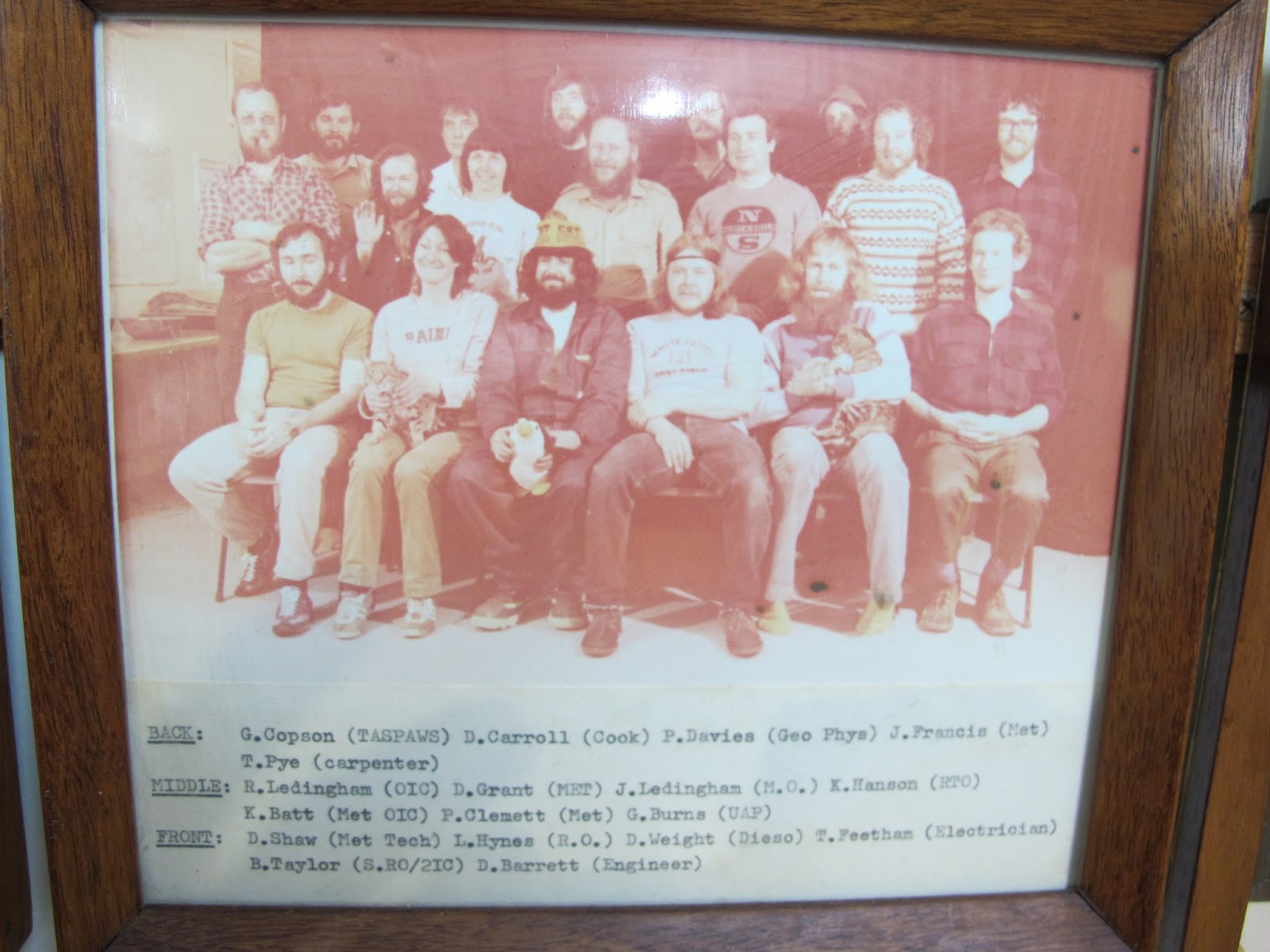
This station photo from 1980 hangs on the wall in the mess, and two station cats appear, clearly companions of expeditioners.
Oh what a joy it would be to  have the company of a feline companion through the long winter. Alas the impact on wildlife here speaks for itself, and the eradication of cats from Macquarie Island has allowed many species regain a foothold  in an ecological balance upset so long ago, with the first arrival of humans.
For a wonderful read on the life of a Ranger involved in the hunting of  Feral Cats on Macquarie Island check out Feral Dilemma, by Michael Anderson, 2014.

The 1980 Macca Station crew, complete with pet cats. Photo: Jacque Comery


July 21: Heritage find on the beach

Another beach treasure hunt. This time rather than finding my own previous nights meal, I noticed a rusted  artefact that had become uncovered after recent high seas on the east coast.
Many areas along this beach were used in the early sealing and penguin oil production days.
I reported the find to the Ranger in Charge, who collected the item and has added it to the store of heritage items that are being collected as they are uncovered and discovered on the island, to prevent them being lost to the sea. 

Artefact on the beach. Photo: Jacque Comery

Artefact. Photo: Jacque Comery


Artefact. Photo: Jacque Comery

Thursday, 2 July 2015

June 29: Heritage artefacts and beach treasure


We have had high winds and big swells overnight, and the Ranger-in-Charge, was headed out to check on some of the heritage sites that are now particularly close to the waters edge. I jumped at the chance to tag along for a brisk walk down the west beach.
In 1917 under the oversight of Joseph Hatch, an Iron Boiler and Digester were established to produce oil from the blubber of seals harvested on the west coast. It was one of the smallest production sites, and it remained in operation for two years until 1919 ,when all sealing operations at Macquarie Island ceased.
In 2003, the boiler and digester was toppled in a huge storm and moved 50 metres from its original site. Following heavy rainfall in 2013 a landslide partially buried the site.  The digester now sits close to the waters edge and with wave action continually changing the shape of the beach, this heritage site remains in  danger of suffering further impact.
The Rangers here on Macca have a big challenge in maintaining these historical sites. An extremely corrosive sub-Antarctic environment takes it's toll on steel and iron work, and when artefacts are placed under threat by natural occurrences, there is limited access for machinery at most sites to assist in any recovery.
On the way back to Station we found an old metal flanged piece of pipe. On closer inspection it was filled with molten glass, and a partially intact ornate old bottle.  It has possibly been uncovered by the recent seas moving sand around the beach or has been dumped on the shore by the big surf.  With all of our strength the two of us could not lift it to carry it up above the wave line, so we photographed it, and took note of it's location to return with a GPS  to record its exact location.  It may be remnant from earlier station days, or even be debris from one of the many ships that were wrecked along this coast. Such fun to find treasure.


Digester on West Beach. Photo: Jacque Comery


The Digester and Boiler taken in 1975 by Archeologist E.A. Mitchener


Digester on the beach. Photo: Jacque Comery


The boiler. Photo: Jacque Comery


Treasure found on West Beach. Photo: Jacque Comery
 
Jacque checking out the glass inside the pipe. Photo: Andrea Turbett


Ornate glass inside the pipe that we found on West Beach. Photo: Andrea Turbett

Friday, 8 May 2015

April 23: Penguin digestors

Penguin digesters on the Isthmus. Photo Rich Youd
Macquarie Island has a long history of exploitation of natural resources, with human activities on the island bringing one species after the other  to the brink of extinction. Today many species have recovered, but the reminders remain.  These penguin digesters were used to boil down penguins that were hunted for their oil. Royal penguins were particularly high in output for their size and were favoured by hunters. Eventually all species were targeted.  Penguins here just stand there and look at you, if not stroll on over to check you out.  They must have been very easy pickings for eager hunters.